


FlightStack
The Intelligence Layer For Terminal Operations
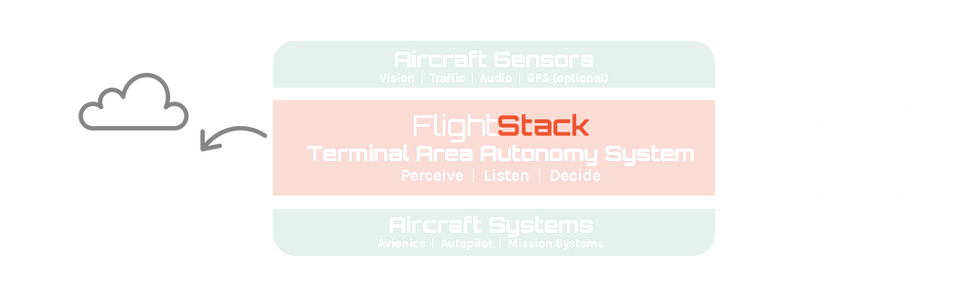
FlightStack is VTI’s AI-enabled perception and autonomy core: the aircraft software layer that perceives the terminal environment, listens to aviation communications, and decides through phase-aware mission logic. FlightStack integrates aircraft sensors, compute, avionics, and mission systems to enable real-world terminal autonomy. It can deploy on existing aircraft compute or as a standalone system.


Live Audio Transcription
Centerline Tracking


Austere Landing Support


Runway Identification & Landing Assistance


Runway Obstacle Avoidance


Crossing Stop & Clearance
Perception
GPS-independent visual awareness for terminal operations.
VTI engineers camera-first perception software that turns runways, taxiways, traffic, hazards, landing zones, and aircraft pose into structured data for pilots, autonomy systems, and aircraft interfaces.
Features
-
Approach-to-land navigation
-
Runway centerline tracking (landing / takeoff roll)
-
Runway hazard assessment
Coming Soon:
-
Taxiway centerline tracking and alerting
-
Taxi hazard assessment
Perception
Detects runway, traffic, and hazards in real time
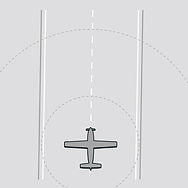
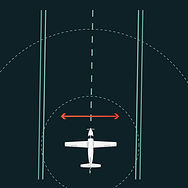
Centerline Tracking
Visually determine aircraft position relative to the runway centerline
System Performance
Lateral Offset Accuracy ± 0.28 Meters
Heading Offset Accuracy ± 0.38 Degrees
Approach Navigation
Visually determine aircraft position relative to the runway during approach
System Performance
Glideslope Accuracy ± 0.11 Degrees
Localizer Accuracy ± 0.04 Degrees
Altitude Accuracy ± 1.97 Meters
Hazard Detection
Detect-and-avoid in terminal airspace with traffic integration during visual approaches.
System Performance
Average Detection & Track Distance 0.78 nmi
False Positive Alert Rate < 0.1%
Modules
Runway Perception
GPS-independent approach navigation, runway centerline tracking, runway hazard assessment
Taxi Perception
raffic/obstacle detection and tracking, taxiway centerline tracking/taxiway localization
Terminal Area DAA
detect-and-avoid in terminal airspace, traffic integration on visual approaches
Integrated Terminal Area Perception: fused runway, taxi, and airborne traffic world model
Communication
From radio audio to structured flight intelligence.
The language stack provides ATC transcription and diarization, communication interpretation and depiction, natural-language avionics interaction, aeronautical/weather query, and clearance parsing across ground and air phases.
Features
-
ATC voice transcription
-
ATIS parsing
-
Taxi clearance parsing
Coming Soon:
-
IFR clearance interpretation
-
Landing and takeoff clearance interpretation
Communication
Understands ATC clearances and communications

Conversational Aeronautical and Weather Query
Provides a natural language interface to relevant aeronautical and weather information, keeping pilots eyes “up and out”
Natural Language Avionics Interactions
Set aircraft configuration and ask about aircraft state with voice
ATC Transcription and Diarization
Transcribes all intercom audio, identifies speaker, and associates with known traffic.
ATC Communication Interpretation and Depiction
Identifies, transcribes, interprets, and depicts
-
ATIS
-
IFR Clearances
-
Landing/Takeoff Clearances
Modules
Ground Comms
ATIS, IFR clearance delivery, taxi clearances
Air Comms
tower, approach, departure, and center parsing
Tactical Comms
dynamic clearance checking, traffic/route conflict detection
End-to-End Dialogue Manager: unified comms integration across ground and air phases
Decision Making
Clearance-aware planning and terminal-phase execution.
VTI’s Mission layer converts perception and communication into state, intent, routing, and guidance: flight-phase logic, clearance state management, strategic taxi planning, tactical replanning, and safe takeoff/landing advisories.
Features
-
Flight phase & clearance state management
-
Voice-interactive pilot assistant
-
Taxi route construction & monitoring
-
Safe takeoff/landing advisory
Coming Soon:
-
Progressive taxi guidance

Decision support is where VTI becomes more than perception. The system manages phase-of-flight logic, interprets operational intent, and constructs or adapts terminal routes based on clearances, constraints, traffic, and aircraft state.
Conversational Queries
Interactive pilot assistant keeps eyes up during critical moments.
Clearance Aware Taxi Routing & Guidance
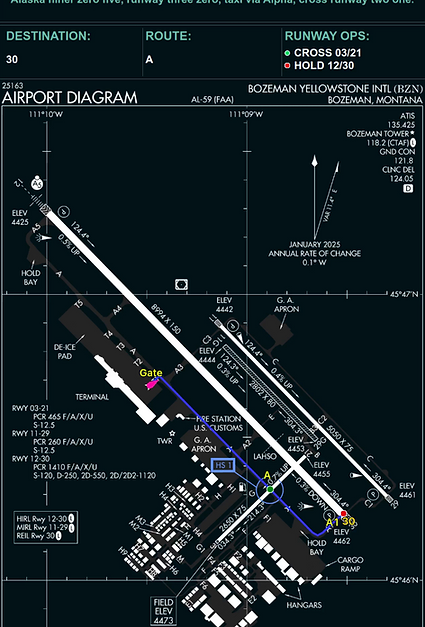
Flight phase module covering taxi, takeoff, approach, landing, rollout, and transition logic, with validated clearance-based taxi routing, adaptive replanning for traffic and constraints, and integrated surface guidance across perception, communications, and planning.
Decision
Plans and directs terminal-phase actions
Software that knows the phase, the clearance, the route, and the next action.
Modules
Flight Phase
phase-of-flight logic (taxi, takeoff, landing, etc.)
Strategic Taxi Planner
validated taxi routes from clearances
Tactical Taxi Planner / Executive
adaptive replanning for traffic and constraints
Integrated Taxi Guidance: end-to-end taxi automation with perception + comms + planning
Why it Matters

Safety
Reduces risk of miscommunication and runway incursions
Resilience
Provides perception and navigation independent of GPS
Workload Reduction
Automates routine but critical tasks
Path to Autonomy
Solves terminal area autonomy first, enabling reduced-crew operations